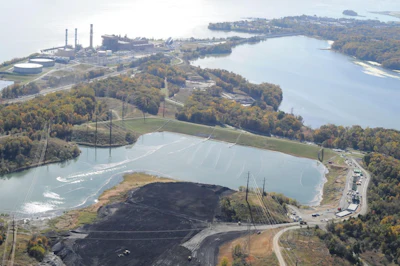
Nearly every major river in the American South has at least one unlined coal ash pit on its banks. Filled with the effluvium of nearby power plants, these dump sites have been leaking harmful contaminants into regional waterways for decades.
Far from sitting by, groups like the Southern Environmental Law Center are fighting in both state and federal court to clean up this pollution. Founded in 1986 by Birmingham environmental lawyer Rick Middleton, the SELC operates across six states - Alabama, Georgia, North Carolina, South Carolina, Tennessee, and Virginia - where coal ash contamination has long been a concern. Following a catastrophic 2008 coal ash spill in Kingston, Tenn., for example, the SELC partnered with area citizen groups to enforce the federal Clean Water Act and demand accountability from utilities.
Today, utilities in North Carolina, South Carolina and Virginia are in the process of cleaning up, containing, or closing their coal ash sites. Meanwhile, the law center continues pushing states such as Georgia and Alabama to step up, notes senior attorney Nate Benforado.
“Water is protected by the CWA, but with metals [from coal ash] leeching into sediment, you have a problem,” said Benforado. “We can’t let this legacy pollution sit there and pollute our waterways in perpetuity, so we looked at where these pits were located and pursued [cleanup] under the CWA.”
Based in Charlottesville, Virigina, Benforado helped enact legislation requiring excavation of 28 million tons of coal ash stored at four Dominion sites in-state. Through SB 1355, the utility must excavate ash pits at Chesterfield Power Station, Chesapeake Energy Center, Possum Point Power Station, and Bremo Power Station.
Next, waste must be hauled to lined landfills, then sealed with an impermeable cap to keep rainwater from seeping through. Beneficial reuse is part of the law as well – at least a quarter of combustion waste must be recycled into cement, concrete or similar products.
Years of advocacy from conservationists, citizens and bipartisan legislators culminated in the law’s passage, despite attempted Trump administration rollbacks of federal coal ash rules, said Benforado.
“When talking about pollution, it doesn’t matter if you’re red or blue,” Benforado said. “If you want healthy drinking water, or don’t want contaminated fish, that’s going to be a non-partisan issue, because those resources belong to everyone.”
What goes around…
Coal ash is the powdery byproduct of burning coal, which utilities have historically mixed with water and dumped into holding ponds or impoundments. Unlined pits leak arsenic, boron, lead and mercury, known carcinogens that damage organs, among other health effects.
Cleanups continue across the south, including efforts to excavate or recycle 126 million tons of coal ash across 14 Duke Energy sites in North Carolina. In 2020, the SELC negotiated a settlement with Duke Energy and the N.C. Department of Environmental Quality, mandating remediation of coal ash lagoons leaking into surrounding rivers, lakes and streams.
SELC attorney Nick Torrey contributed to the effort, part of a years-long journey that included Duke Energy’s coal ash spill into the Dan River. The case resulted in tens of millions of dollars in penalties, with three Duke Energy subsidiaries pleading guilty to nine Clean Water Act criminal violations.
The decision also came when North Carolina regulators were “shielding” utilities through lenient state enforcement actions - a tactic intended to block citizens' federal lawsuits from moving ahead, said Torrey.
“The state has come around since then, after a change in administrations and public outcry about pollution and under regulation,” Torrey said. “To be in this together shows how big and serious this problem is, and the risks of spills from these sites. It took years of fighting for community groups – and the state getting behind the people – to bring the issue home.”
South Carolina conservationists have enjoyed their own victories as well, obtaining settlement agreements to extract over one million tons of ash from two sites. Fresh from law school when he joined the SELC in 2011, Torrey helped secure a settlement a year later to remove coal ash from the Wateree Plant along the Catawba-Wateree River.
In both instances, contaminants were recycled into concrete or moved to dry storage away from rivers, said Torrey.
“[Cleanup] is a big undertaking for utilities, because they’ve been able to ignore it for so long,” Torrey said. “But with federal regulations and enforcement, they’ve had to create infrastructure that’s important to getting this problem under control.”
With precedent set, the law center is collaborating with riverkeepers and community groups in Georgia to clean up old storage sites. As of 2026, Georgia Power has committed to removing at least 65% of coal ash from its unlined pits. In Alabama - a state that has generally resisted cleanup mandates - the SELC sued on behalf of Mobile Baykeeper to force excavation of the Plant Barry coal ash lagoon along the Mobile River.
Looking ahead, Torrey expects such suits to spread as the country phases out an antiquated energy source.
“This is many decades in the making, but communities are speaking up,” said Torrey. “We are in a position where a lot of the coal ash in the south is being cleaned. It shows what can and should be done throughout the country.”