
Voters in eight states will decide confirmed energy measures on Tuesday's ballot. The list is short on statewide questions but long on local fights with years of consequences: a public power takeover vote in Michigan, long-term utility franchise renewals in four cities, and a wave of local data center restrictions. Here are the ones most worth following, and what each one would and would not do.
Two statewide questions
Colorado Amendment 82 would write a right to buy and sell natural gas for cooking and heating into the state constitution, for homes and businesses alike. The official ballot analysis says it may limit state or local governments' ability to enforce existing or future natural gas regulations. It needs 55 percent of the vote to pass.
Michigan Proposal 2 would ban regulated electric and gas utilities, including DTE and Consumers Energy, from making campaign contributions. It also covers entities holding $250,000 or more in annual government contracts, and it expands disclosure rules for political communications.
A public power vote in Ann Arbor
Ann Arbor, Mich., Proposal E would amend the city charter to require the city to create a municipal electric utility governed by a nine-member board, five elected and four appointed by the city council. The charter language requires just-transition, fossil fuel phaseout, renewables and ratepayer equity policies. The city is in DTE territory.
Franchise votes with decades-long consequences
- Denver Question 2K: a 20-year Xcel Energy (Public Service Company of Colorado) franchise starting Jan. 1, 2027, covering undergrounding of overhead lines, infrastructure safety and emergency management coordination.
- Tucson Proposition 421: renews Tucson Electric Power's franchise agreement. TEP has operated under the current agreement since November 2000.
- Chandler, Ariz., Question 1: a 25-year Arizona Public Service franchise, Jan. 1, 2027 through Dec. 31, 2051, with a 2 percent franchise fee to the city.
- Casa Grande, Ariz., Proposition 407: a 25-year APS franchise for electric facilities in city rights-of-way.
New local revenue models
Eugene, Ore., Measure 20-388 would require large retailers to obtain a city license, with the revenue funding a city clean energy fund. The measure qualified by citizen petition.
Ashland, Ore., Measure 15-243 would amend the city charter to require voter approval for utility bill fees and taxes unrelated to providing utility service. It exempts inflation-level increases, state and federal charges, franchise fees and contractually required charges.
California utility user taxes
Five California measures would create or extend local taxes on electric, gas and other utility bills:
- Isla Vista Community Services District Measure E: a new tax of 6% on trash, water, electricity and sewer and 7% on natural gas, projected at about $1.2 million a year, in addition to the district's 2018 Measure R tax.
- Marina Measure Q: a new 7% tax with low-income rates, about $3.83 million a year until ended by voters, for emergency services, facilities, water supply, streets and general city services.
- San Marino Measure U: extends the existing 6% tax, about $2.62 million a year, until ended by voters.
- Union City Measure II: extends the existing 5% tax for nine years with no increase, about $7 million a year, with senior and low-income exemptions.
- South Gate Measure SG: a new 8 percent tax on electricity, water, natural gas, cable and phone bills, estimated at $10.4 million a year, according to LAist.
The data center wave
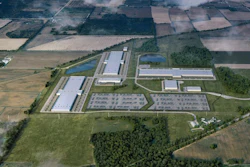
Ballotpedia is tracking 41 local data center measures on Tuesday's ballot across 10 states. According to the tracker, Ohio alone accounts for 21, many capping or banning facilities above 25 megawatts of peak electrical demand.
The tracker lists seven in Illinois, mostly advisory; three in Kansas, including El Dorado, which would also ban large battery storage, and Ottawa, with a 25 megawatt cap; and four moratorium or prohibition votes in Maine.
Ballotpedia also shows single items in Alhambra, Calif.; Edgewater, Fla.; Harwood, N.D.; Downe Township, N.J.; Boulder City, Nev.; and Janesville, Wis.
Ballotpedia reports that four earlier 2026 data center votes all went against developers, including a 90% moratorium approval in Nottingham, N.H.
Elsewhere statewide
- Rhode Island Question 5: a $55 million green economy bond, including $25 million for resilient infrastructure and $7 million for watershed restoration. Climate adaptation rather than energy supply.
- Rhode Island Question 3: a $100 million economic and infrastructure bond, with $55 million for site development including utility installation.
- Massachusetts Question 6: dedicates existing sales tax revenue from sporting goods, recreational vehicles and golf courses to land and water conservation. It is not a new tax.
- Arkansas Issue 4: up to $500 million in bonds, primarily for water projects.
- Arizona Proposition 141: bans vehicle-miles-traveled taxes or fees and mileage monitoring without consent. Borderline energy relevance: road funding as EV adoption erodes gas tax revenue.
Already decided in 2026
Earlier this year, Cheney, Wash., renewed a 6% electrical energy tax for street and sidewalk repair; Tulsa, Okla., approved a natural gas franchise renewal; Laramie County, Wyo., approved a sales tax covering municipal vehicles, electric systems, water and sewer; and Richland County, Ohio, approved a referendum prohibiting certain solar and wind facilities.
Onward
For energy utilities and developers, Tuesday's results could have consequences well beyond the communities casting ballots. Franchise renewals will determine how utilities operate in local rights-of-way for decades, while public power and data center measures could reshape who controls electricity infrastructure and where new demand can be built.
The data center votes are particularly worth watching. As utilities plan billions of dollars in generation and grid upgrades to accommodate large new loads, local voters are increasingly weighing in on whether those projects can move forward. The results could add another layer of uncertainty to infrastructure planning in some of the country's fastest-growing electricity markets.