Data centers and the resources they use have been hot button topics as large-scale projects are rolled out en masse. For the rural communities where these projects are being proposed, a single data center can be an unprecedented disruption to the local energy grid, in some cases instigating massive energy infrastructure projects that span counties, utilities, and states.
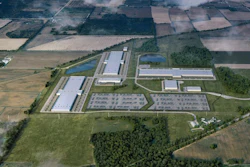
In Port Washington, Wisc., the 1.5GW Lighthouse data center being constructed by Vantage Data Centers includes four single-story data centers across 672 acres. The project is slated to be operational by 2028.
While the Lighthouse data center has a large footprint, the energy infrastructure upgrades needed to meet its power demand traverse six counties, including five greenfield substations, upgrades to existing substations, an E-STATCOM (Enhanced Static Synchronous Compensator), as well as miles of new and uprated transmission lines to connect them all. To meet the data center’s energy demand, Vantage is collaborating with We Energies, a local electric utility, to fund and build sixteen renewable energy projects as well.
This parallel infrastructure project is called the Ozaukee County Distribution Interconnection Project. It is being carried out by the American Transmission Company (ATC), a Midwestern transmission provider that serves five million customers across Wisconsin, Michigan, and Illinois with almost 10,000 miles of transmission lines and over 560 substations.
“Transmission upgrades can be needed for several reasons, including customer requests, growth in electricity demand, new generation connecting to the system, operational needs, reliability planning, economic and public policy considerations, and equipment approaching the end of its useful life,” an ATC representative said in an email. “In the case of the Ozaukee County Distribution Interconnection Project, the proposed project is needed to reliably serve a large new load addition in the Port Washington area while maintaining safe and reliable operation of ATC's transmission system.”
Connecting data centers to the grid
For transmission providers and electric utilities that serve rural America, one data center customer can put grid reliability into question, calling for new energy sources, new substations and transmission lines, and upgrades to existing transmission lines and substations. Electric utilities have to “make room” for high load users to connect.
“Upgrading an existing transmission corridor to 345 kilovolts can involve rebuilding the power line with new structures, conductors and other equipment designed to operate at the higher voltage. It also may require modifications to substations and other facilities,” explained an ATC representative over email.
Why five substations for one new customer?
To meet the demand of a new gigawatt customer, the grid has to be reconfigured. Substations play various crucial roles throughout the transmission of energy to make this possible, from power generation to on-site use.
For example, energy generation projects are being built in tandem with the data center boom as electric companies scramble to meet the demands of gigawatt customers. These new energy sources typically require step-up substations adjacent to power plants and renewable energy farms so power can be placed on transmission lines and feed the increased demand on the grid.
As more energy is injected into the grid, the new and uprated transmission lines deliver that increased voltage to other substations, either for distribution or further transmission. Those substations also receive the higher loading, so new and uprated transmission substations are built to properly direct the current, protect the grid from overvoltage, and transform voltages to transmission and distribution lines.
As energy reaches its final destination, some gigawatt customers need an on-site distribution substation. The Lighthouse data center will have an on-site distribution substation so that it can access a 345kV transmission line directly instead of using local distribution lines that cannot provide bulk energy. On-site substations also protect data centers from high voltage events and distribute electricity to where it’s needed at the facility, similar to the grid.
“For a very large electric load, an on-site interconnection substation can provide the point where the facility connects to the high-voltage transmission system,” explained the ATC representative. “For the Ozaukee County project, the end-use customer requested a dedicated 345-kV transmission interconnection substation on its property. The customer's own transformers would reduce the voltage from 345-kV to the voltage used by its distribution system.”
In addition to the on-site substation, the Ozaukee County Interconnection Distribution Project may also include an E-STATCOM to further address rapid fluctuations in electricity demand at the Lighthouse data center.
“Studies identified an E-STATCOM as necessary to mitigate rapid load variations associated with the proposed data center load and maintain compliance with ATC's planning criteria,” shared an ATC representative. “The proposed E-STATCOM, which will be fully funded by the customer, would be located adjacent to the Decker Substation on the developer's property.”
Interconnected
Data centers and substations go hand in hand. Gigawatt demand supersedes most distribution line applications used by commercial and residential customers, precipitating large-scale infrastructure projects for the utilities providing them power, particularly in rural communities where gigawatt customers can upend prior long-term planning.
As data center construction grows, substations and other energy infrastructure investments will follow.