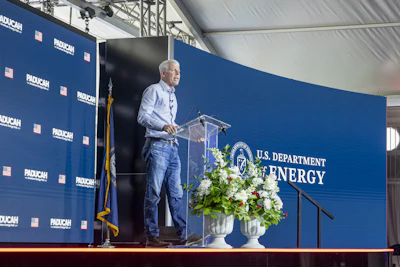

The U.S. Department of Energy has selected Brookfield Asset Management to redevelop the former Paducah Gaseous Diffusion Plant into a large-scale AI and energy campus, marking one of the federal government's most ambitious efforts to repurpose a former Cold War nuclear site for next-generation infrastructure.
Brookfield's proposal calls for a 1.8 GW AI data center campus supported by 2 GW of new natural gas generation, 2.6 GW of battery energy storage, and upgrades to existing transmission infrastructure. DOE said the project could attract as much as $100 billion in private investment over time.
NextEra Energy is expected to develop and own the power generation assets, while Brookfield would lead development of the AI campus. The project remains subject to environmental reviews, permitting, and additional agreements before construction can begin.
The Paducah site, in western Kentucky, was built in the early 1950s to enrich uranium for the nation's nuclear weapons program and later commercial nuclear fuel production. Enrichment operations ended in 2013, and DOE has spent more than a decade decommissioning facilities and remediating the site.
Unlike a greenfield development, Paducah already offers many of the assets large industrial users need, including thousands of acres of industrial land, established transmission infrastructure, and a history of supporting some of the nation's largest electrical loads.
The selection reflects DOE's broader strategy of repurposing former federal energy sites for new industrial development. As electricity demand rises from AI, advanced manufacturing, and electrification, former nuclear facilities are increasingly viewed as strategic locations because they already possess grid connections and infrastructure that would be difficult and time-consuming to replicate elsewhere.
If completed (estimated by 2031), the Paducah project would become one of the country's largest integrated AI and energy developments, transforming a former uranium enrichment complex into a new hub for computing and power infrastructure.