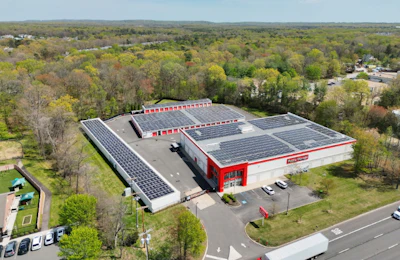
Public Storage is a leading U.S. self-storage facility operation with more than 4,600 locations across 41 states. An abundance of real estate is taking on new purpose with the company’s plans to build 60 rooftop solar installations across northern Illinois over the next two years.
If all goes to plan, the partnership with developer Solar Landscape will deliver 44 megawatts to the grid within ComEd’s 11,400-square-mile territory. Meanwhile, Illinois utility leaders and solar advocates say the model has potential to transform swaths of underutilized property into high-capacity generation sites.
Added capacity is key as data centers and other operations push regional power demand past its limits, noted Kavi Chintam, campaign manager for Illinois at Vote Solar, a national nonprofit advocating for equitable solar access.
“Increasing the amount of energy we have in-state is very important, and projects like this is how we can do that,” said Chintam. “It’s a smart use of space that’s already built, delivering a huge impact that does not require much additional infrastructure.”
Community solar expansion is supported by state policies such as the Climate and Equitable Jobs Act (CEJA) and the Clean and Renewable Grid Affordability Act (CRGA). Along with the 60 installations deriving from the Solar Landscape collaboration, ComEd expects to erect a total of 400 community solar projects across its footprint before year’s end.
To date, ComEd has connected more than 1.8 gigawatts of distributed energy resources, boosting regional grid capacity and lowering power costs for customers, said Taral Patel, director of projects and contract management for the utility.
“Additional DERs are coming online at a critical time,” Patel said in an email. “Portfolios like (Public Storage) offer a clean energy solution that can close the supply gap as demand continues to rise and projected generation falls short. DERs boost grid capacity even as we wait for large generation infrastructure to come online – a process that takes years of planning, permitting, design and construction.”
Once complete, ComEd’s Public Storage portfolio will power 6,150 households while delivering an estimated $750,000 in annual electricity savings. The average residential subscriber is expected to save approximately $120 annually on electricity costs, according to the utility.
Patel said that converting unused rooftops into community solar highlights a push across utilities, developers and property owners to reshape the energy landscape.
“There is an abundance of unused rooftop real estate across Chicago and northern Illinois – millions of square feet of space that could be utilized to install solar panels,” Patel said. “Rooftops are a fast, scalable opportunity to increase grid capacity and deliver solar savings to customers. And, placing rooftop solar in densely populated areas puts generation right at the load center, which means we’re bringing new capacity online close to where customers use electricity, which in turn supports reliability.”
Taking action
Although Illinois has plentiful land for ground-mounted solar, these installations are frequently located miles away from population centers, added Chintam of Vote Solar. Rooftop projects are a boon for renters, households with shared roofs, or low-to-middle-income families without access to solar, she said.
To connect lower-income communities to the grid, ComEd leverages developer partnerships as well as state-supported programs like Illinois Shines. Underutilized properties generally offer quick turnarounds for solar initiatives, not to mention a template for the type of smaller-scale projects attractive to solar developers, Chintam said.
“A property owner can provide a roof, while the developer finances the system through Illinois Shines,” she said. “There are big-box stores and warehouses that have these flat spaces. Plus they have many locations, meaning these projects are not just one-offs. The idea is to have a portfolio that can allow for faster deployment.”
Backed by state mandates under CEJA, Illinois's solar market deployed 2.5 GW of solar capacity in 2024 alone. The newly announced rooftop projects point to the importance of state-level action in an era of unprecedented federal disinvestment, noted Jessica Garcia, energy policy director with the Illinois Environmental Council, an umbrella group for a range of state-based advocacy organizations.
“Trump’s Big Beautiful Bill cancelled the federal tax credits that helped facilitate community solar development, but these programs continue to thrive and deliver benefits to Illinoisans thanks to CEJA and CRGA,” Garcia said in an email. “IEC is excited to see partnerships like the one between Solar Landscape and Public Storage taking off to provide solar capacity, support new construction jobs and the growing clean energy workforce, and deliver critical energy savings to Illinoisans.”
‘Every little bit helps’
Garcia said that despite the industry's steady expansion, untapped potential remains for rooftop solar development – per Lumen Energy’s rooftop solar atlas, medium and large commercial and industrial buildings hold 581 GW of rooftop potential.
More than 80% of Cook County buildings are suited for this work, creating a profitable avenue for landlords eager to host installations, said Garcia. Placing power generation on storage units or other low-load buildings is beneficial for grid resilience as well, she added.
“When a commercial building has a large rooftop footprint, rooftop solar can supply more energy than the building itself needs for its own daily operations, creating the perfect opportunity to add energy supply to the grid,” said Garcia. “The building can power itself and send clean energy back to the grid, effectively lowering bills for other consumers and bolstering grid resiliency.”
A patchwork of permitting rules around grid interconnection remains an impediment for new rooftop projects. Chintam recommends that prospective solar hosts set clear targets, including cost savings, system size and specific neighborhoods targeted for access.
“These projects continue to be important in creating energy when demand is at an all-time high,” said Chintam. “Every little bit helps, and any relief is good relief.”