
In Buffalo, N.Y., a brick electrical substation built in 1916 is beginning a new chapter in the city's industrial history.
The Perry Street facility has served the surrounding neighborhoods for more than a century, dating to an era when Buffalo was a major manufacturing center and Western New York was helping establish the foundations of America's electric power system.
Today, the neighborhoods surrounding the substation are changing. Former factories and warehouses are becoming apartments, offices, restaurants, and retail destinations. New development is bringing additional electricity demand, including individual projects requiring more than 1 megawatt of power.
That growth is creating a problem for the city's aging distribution infrastructure.
For decades, National Grid, an investor-owned electric and natural gas utility serving customers across New York and Massachusetts, has delivered electricity to much of Buffalo through a 4,160-volt distribution system. The network has served the city reliably, but its voltage limits the size of the individual customer loads it can accommodate economically.
National Grid recently completed a $32-million modernization of its Perry Street substation to address that constraint. The project added 13,200-volt distribution capability, giving the utility another option for serving larger customers in an area historically supplied at 4,160 volts.
The work involved installing new transformers and switchgear, redesigning portions of the historic facility, and temporarily relocating electrical service so crews could complete construction without interrupting customers.
Perry Street is the first of approximately a dozen Buffalo substations National Grid expects to modernize, rebuild, or replace as part of a broader infrastructure program.
For the utility, the project illustrates a challenge confronting electric distribution systems across the country: how to accommodate changing electricity demand while rebuilding infrastructure that has already been operating for generations.
When redevelopment outgrows the distribution system
About a mile from downtown Buffalo, the Larkinville neighborhood has undergone substantial redevelopment over the past two decades.
Buildings that once supported the city's manufacturing and warehousing industries have found new uses. Former industrial properties now accommodate mixed-use development, residential apartments, offices, and commercial tenants.
National Grid Regional Director Ken Kujawa said the area's transformation has steadily changed the electricity requirements of individual customers.
"What we've seen is the loads that customers were presenting to us were coming in greater than what our 4,160-volt system could accommodate from a capacity standpoint," Kujawa said.
The existing system generally allows National Grid to serve individual loads up to approximately 1 MW. As developers introduce larger buildings and more electrically intensive uses, some projects are exceeding that threshold.
The alternative has been to connect those customers to Buffalo's 23-kV underground distribution network. That approach can accommodate larger loads, but it introduces additional infrastructure requirements and construction costs. Depending on the location, serving a new development at 23 kV may require underground conduit, cable installation, and street excavation.
"The only option that we had in those cases has been to serve customers at 23,000 volts, which is our underground system here in Buffalo," Kujawa said, "and if we have to serve somebody using our underground system, it now becomes very costly for both National Grid and the customer."
The new 13.2-kV service at Perry Street provides an intermediate delivery option. According to Kujawa, it will allow National Grid to serve customer loads generally ranging from more than 1 MW to approximately 2.5 MW without necessarily relying on the more expensive underground system.
That distinction matters for developers considering projects in established urban neighborhoods, where the availability and cost of electrical service can influence construction schedules and project economics.
Kujawa said National Grid expects continued investment in Larkinville, including redevelopment of additional industrial properties. Across the surrounding neighborhoods, as many as two dozen mixed-use, affordable housing, commercial, and retail projects are in planning or construction, according to the utility.
Electrification is also changing the equation. Electric heating systems and vehicle charging infrastructure can increase the power requirements of buildings that historically depended on other energy sources.
By introducing a higher distribution voltage, National Grid can accommodate a wider range of development without requiring every larger customer to connect through the 23-kV network.
"By being able to introduce 13.2 kV, we're going to make the city more attractive for developers because we'll be able to respond more quickly and efficiently when they present us with development projects," Kujawa said.
Rebuilding a substation inside a century-old structure
Providing that additional capacity required extensive work inside the Perry Street facility.
National Grid evaluated multiple approaches to upgrading the station, including replacing equipment and modifying the existing electrical configuration. Ultimately, the utility chose to reuse the historic building while rebuilding much of the electrical infrastructure inside.
 National Grid
Anthony Osman, National Grid's maintenance and construction manager for substations in Western New York, said the project included new transformers, new switchgear, and replacement of high- and low-side electrical connections.
The physical construction effort took approximately one year, following a much longer period of planning, engineering, and coordination.
Working inside a structure built in 1916 presented challenges that would be less common at a newly constructed substation. The existing building had to accommodate modern equipment, electrical clearances, and operating requirements despite having been designed for an entirely different generation of electrical technology.
The facility's history includes an earlier role as a 25-cycle electrical installation, reflecting a period when electric utilities operated systems with different frequencies and configurations. Frequency-changing equipment associated with that earlier use had been removed long before the latest modernization.
Still, the building's physical characteristics and legacy configuration shaped the engineering work.
"We're really digging into something that's been around for a while, right?" Osman said. "That's probably one of our biggest challenges, which ended up in the end probably being the best thing for us because we've utilized the space, we've created growth where we can have it."
Rather than abandoning the site, National Grid redesigned the existing space around its current equipment standards and future distribution needs.
The resulting facility provides the new 13.2-kV capability while retaining room for additional equipment.
According to Osman, National Grid plans to install another transformer and additional distribution feeders as the surrounding area's electricity requirements increase.
That ability to expand was an important consideration in a project intended to support development well beyond its initial commissioning.
The completed modernization also reflects a broader approach to utility infrastructure investment: making use of existing facilities and locations where practical, while replacing equipment that no longer meets current operating or capacity requirements.
For urban utilities, established substation sites can be valuable assets. They already occupy strategic locations within the distribution network, often in neighborhoods where acquiring new property and developing additional electrical infrastructure would be complicated.
But those advantages must be weighed against the challenges of retrofitting buildings that may be decades older than the equipment being installed.
At Perry Street, National Grid determined that the existing structure could accommodate both the immediate modernization and future expansion.
Keeping the lights on during construction
The engineering challenge extended beyond fitting new equipment into an old building.
National Grid also needed to keep the surrounding neighborhood energized while crews rebuilt the substation.
For customers served by an operating facility, a yearlong construction project cannot simply mean taking the station out of service until the work is finished.
The utility's solution was to establish a temporary electrical supply within the substation property.
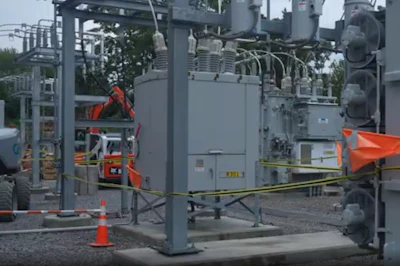
Osman described the arrangement as a "boutique substation," a smaller pad-mounted installation consisting of equipment including a transformer and recloser.
The temporary configuration provided an alternative source of electrical service while crews worked on the permanent station.
"It's got a pad-mounted transformer recloser. It's kind of a temporary feed that was installed in the back of the yard," Osman explained. "That continued to feed the customers while we could perform those upgrades."
Once the permanent equipment was installed and ready for service, National Grid transferred customers from the temporary arrangement back to the rebuilt substation.
Osman said customers experienced no interruption during that transfer.
The temporary equipment was then removed and returned to National Grid's inventory for use on future projects.
That reusable approach has implications beyond Perry Street. As utilities undertake successive substation upgrades, temporary electrical infrastructure can provide a means of maintaining service without requiring a permanent installation for every construction project.
But keeping customers connected also depends on planning beyond the immediate construction site.
Vinny DiCiccero, National Grid's director of distribution planning and asset management for Upstate New York, said the utility must coordinate individual projects with the operating conditions of the broader distribution network.
That includes evaluating available system capacity, determining which facilities can support temporary configurations, and scheduling work around periods of higher electrical demand.
In Upstate New York, the distribution system generally experiences its highest loads during summer. That can influence when certain equipment can be removed from service or when construction activities can proceed with acceptable operating risk.
"There are times we have to be seasonally thoughtful," DiCiccero said. "So, you know, in New York State, our peak is generally in the summer season from a loading perspective."
As National Grid prepares for additional substation upgrades, construction sequencing will remain an important part of the modernization program. Each project must be coordinated with the infrastructure around it, particularly where system capacity is limited and customers depend on relatively few available supply paths.
The Perry Street project demonstrates how temporary equipment, advance planning, and coordination between engineering and field construction teams can allow major electrical infrastructure work to proceed while the surrounding distribution system remains operational.
Replacing aging assets versus building for new demand
The Perry Street modernization raises a broader question facing utilities nationwide: When does aging infrastructure require replacement, and when should replacement become an opportunity to expand capacity?
Those decisions are related, but they are not identical.
DiCiccero said National Grid generally evaluates projects within two broad categories.
Some investments are intended to increase capacity or introduce new system capabilities, as at Perry Street. Others are primarily driven by asset condition and involve replacing aging equipment with newer equivalents.
The difference can significantly affect the scope and cost of a project.
An aging transformer, for example, may require replacement even if electricity demand remains unchanged. But if a utility also expects substantial growth in the surrounding service territory, replacing the equipment with an equivalent unit may leave the system facing another capacity constraint in the future.
At Perry Street, redevelopment helped determine the scale of the investment.
DiCiccero said National Grid already had plans to rebuild portions of Buffalo's aging electrical infrastructure, regardless of the recent economic development.
Without the anticipated load growth, however, the utility might have pursued a more conventional replacement strategy rather than introducing a higher distribution voltage.
"If you were to look at just the asset condition piece to this whole thing, I think that's, you know, an area where we would still look to upgrade, but we wouldn't necessarily put in the same voltage class, right?" he said.
The distinction is important as utilities evaluate how to spend capital across increasingly complex distribution networks.
Replacing equipment based solely on age and condition can address reliability concerns. Incorporating future load forecasts can also position the network to accommodate additional development, electrification, and changing customer requirements.
The challenge is determining how much additional capacity to install, where it will be needed, and when the investment should occur.
For National Grid, Perry Street represents the intersection of those considerations.
The century-old facility was an established part of Buffalo's distribution network, while surrounding redevelopment created a need for additional electrical capacity.
A 20-year transformation of Buffalo's electrical network
The Perry Street modernization is one component of a much larger effort to change how electricity is distributed throughout Buffalo.
National Grid expects to modernize or rebuild approximately a dozen substations in the coming years, with additional portions of the city transitioning to 13.2-kV delivery.
Some existing substations will be upgraded. Others may be retired, while new facilities will be constructed where necessary.
Kujawa said the broader distribution planning effort extends approximately 20 years into the future.
That longer timeline reflects the complexity of transforming an established urban electrical network.
Higher-voltage distribution cannot be introduced everywhere simultaneously. Utilities must coordinate substation investments with feeder construction, existing customer connections, load growth, and the condition of surrounding infrastructure.
DiCiccero said National Grid is approaching that work through a coordinated planning process intended to determine where upgrades should occur and how individual projects can build on one another.
The utility also participates in industry benchmarking efforts, including collaboration through the Electric Power Research Institute, to compare infrastructure planning and modernization approaches with other electric utilities.
DiCiccero said the challenge of serving larger customer loads through historically lower-voltage distribution networks extends well beyond Buffalo.
Similar conditions exist in other established cities, including parts of National Grid's neighboring Massachusetts service territory.
The common objective is to introduce higher distribution voltages where growing customer demand makes them necessary, while coordinating those upgrades with the continued operation of existing infrastructure.
National Grid is still evaluating lessons from the Perry Street project. Formal reviews of the construction and planning process have not yet been completed, according to DiCiccero.
But the experience will inform how the utility sequences future work and makes use of the newly modernized station as additional upgrades proceed.
Preserving Buffalo's electrical history
 National Grid
The substation sits in a residential neighborhood, surrounded by homes and other buildings that have grown around the facility over more than a century.
Rather than treating the station solely as an industrial installation, National Grid incorporated public artwork into the exterior renovation.
Murals along the brick building depict Thomas Edison, Nikola Tesla, George Westinghouse, and Jacob Schoellkopff, figures associated with Western New York's early electricity industry.
The artwork recognizes a period when Niagara Falls and Buffalo played important roles in the development of long-distance electric power transmission and the competition between alternating- and direct-current technologies.
Kujawa said the utility wanted to preserve that connection while making the facility more visually appealing to the surrounding community.
"We wanted to be a good neighbor and try to take an electric station and make it look as appealing and welcoming as you can with an electric station," he said.
More than a century after its construction, the Perry Street substation remains part of Buffalo's electrical infrastructure. Its new equipment and expanded distribution capabilities reflect how much the demands on that infrastructure have changed.
The broader challenge for National Grid is to carry that modernization across the city, replacing aging equipment and introducing additional capacity without disrupting the customers who already depend on the system.
For utilities facing similar conditions, Perry Street offers a practical example of how that work can be approached: preserve usable infrastructure, plan for future demand, build temporary service arrangements where necessary, and coordinate construction around the operating requirements of the existing grid.