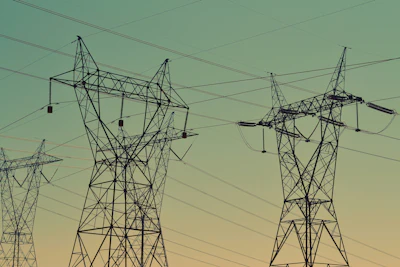

The United States does not have an energy problem. It has a delivery problem.
Developers have proposed enough solar, wind, and battery storage to power the country twice over. The economics have never been more favorable. The technology is proven. The capital is available.
What is not available is a reliable path from the generator to the grid — and from the grid to the people who need the power.
This guide explains why. Two infrastructure failures, compounding each other, are blocking the energy transition at its most basic level: the physical connection between supply and demand. Understanding both — and how they interact — is now essential for anyone making generation, investment, or planning decisions in today's electricity market. Before a power plant can sell electricity, it needs permission to plug into the grid. That process is called interconnection. Simple enough.Ilkhom Kasimov
Every new power plant — solar farm, wind project, battery facility — must apply for interconnection before it can operate. The developer submits a request to the relevant transmission authority: an ISO, an RTO, or a regulated utility. That authority then conducts a series of technical studies to determine what grid upgrades the project requires, and assigns those costs to the developer.
In principle, this is a reasonable process. It ensures that new generators don't destabilize a system that 160 million Americans depend on every day. The studies confirm that the new plant can safely deliver power without causing voltage problems, overloading transmission lines, or creating reliability risks for other grid users.
The process was designed for a different era — one in which a handful of large thermal plants sought grid connection each decade. It was not designed for what came next.
 Except 2,300+ gigawatts of projects are currently in line. That's nearly double the entire installed capacity of the U.S. power system. The process has become the problem.Ilkhom Kasimov
According to Lawrence Berkeley National Laboratory's annual Queued Up report — the definitive tracking study of U.S. interconnection activity — there were approximately 10,300 projects actively seeking interconnection at the end of 2024, representing more than 2,300 gigawatts of proposed generation and storage capacity. To put that in context: the entire existing U.S. power system generates roughly 1,200 gigawatts. The queue holds nearly twice as much.
Solar accounts for 956 GW. Battery storage represents another 890 GW. Wind contributes 271 GW. Proposed natural gas totals just 136 GW — a clear signal of where private capital is flowing.
But volume in the queue does not translate to capacity on the grid. Only 13 percent of projects that entered the queue between 2000 and 2019 had reached commercial operation by 2024. Seventy-seven percent had been withdrawn — often after years of study costs, delays, and shifting economics.
Wait times have roughly doubled over two decades. Projects that once moved from application to operation in under two years now typically take four to five. The cost to interconnect has risen nearly 90 percent over the past decade. Those costs don't stay with developers — they flow through to ratepayers in wholesale prices and retail rates.
 Even if your project clears interconnection, it still needs a highway to travel. That's transmission — the high-voltage network that carries power from where it's generated to where people live. Problem: the highway was built for a different era.Ilkhom Kasimov
Interconnection is the on-ramp. Transmission is the highway itself.
The U.S. high-voltage transmission network — lines operating at 115 kilovolts and above — was largely planned and built between the 1950s and 1980s. It was engineered around a specific logic: large, dispatchable thermal plants located near population centers and fuel sources. Coal plants near Appalachian coal. Gas plants near pipeline infrastructure. Nuclear plants near major load centers. The grid reflected the geography of the fuel.
That logic no longer applies. The transition to renewable generation follows a completely different geography — one determined by sun, wind, and water, not by proximity to fuel supply. And that mismatch between where the energy is and where the grid was built is the second major constraint on the American energy transition.
 The best solar is in the Southwest. The best wind is in the Plains. The best offshore wind is on the coasts. None of those places are where most Americans live. The highways don't go where the power needs to go.Ilkhom Kasimov
The Department of Energy's 2024 National Transmission Planning Study found that meeting future demand and reliability requirements would require building approximately 5,000 miles of new high-capacity transmission lines per year. In 2024, the United States built 888 miles — less than one-fifth of what is needed, and the third-slowest year for high-voltage transmission construction in the past 15 years. In 2013, the U.S. built nearly 4,000 miles in a single year.
The cost of this underinvestment is measurable. DOE's analysis found that accelerating transmission expansion could reduce total U.S. electricity system costs by $270 to $490 billion through 2050, primarily through avoided fuel costs and reduced need for redundant generating capacity elsewhere on the system. Without adequate transmission, renewable energy that gets built gets curtailed — produced but not delivered, generating no revenue, serving no load.
The barriers are familiar: multi-jurisdictional permitting that can stretch a decade, unresolved cost allocation disputes between states and utilities, and limited incentive for incumbent transmission owners to build regional infrastructure that primarily benefits competing generators. FERC's Order 1920, issued in May 2024, introduces mandatory 20-year planning horizons and broader cost allocation frameworks. It does not dissolve the permitting challenge.
 Here's the painful part. These aren't two separate problems. They compound each other. Fix one without the other and most of the capacity still never reaches the grid.Ilkhom Kasimov
A developer who successfully clears the interconnection queue — after four or five years of studies, costs, and uncertainty — may still find that the regional transmission network lacks the capacity to carry their output to the load centers where it has market value. The power gets produced. It doesn't get delivered. The project's economics collapse.
The inverse is equally true. Build new transmission capacity to open up a renewable resource zone and the queue may still be too backlogged for developers to connect in time to use it. New highways with no on-ramps.
This compounding dynamic is why the most sophisticated actors in the sector now treat interconnection reform and transmission expansion as inseparable. FERC's back-to-back issuance of Order 2023 in July 2023 and Order 1920 in May 2024 reflects that recognition at the regulatory level.
For operators and developers, the practical implication is direct: project economics cannot be assessed at the busbar alone. The levelized cost of energy at the point of generation does not account for interconnection study costs and delays, transmission upgrade requirements, curtailment risk from congestion, or basis risk from location-specific pricing. The all-in cost of delivering power to market can differ dramatically from the busbar figure — and those differences increasingly determine whether a project succeeds or fails.
 Regulators are finally working on both problems at once. Whether the reforms move fast enough — and hold — is the question the industry is watching.Ilkhom Kasimov
FERC Order 2023 shifts interconnection from a sequential, first-come-first-served study process to a cluster-based approach, studying groups of projects simultaneously. It also requires developers to post larger financial deposits before entering the queue, intended to reduce speculative filings and improve the quality of the active pipeline. Early LBNL data shows a modest 12 percent reduction in queue volume — but most of the projects in that data were submitted before the new rules took effect. The true test will come as Order 2023 cohorts begin reaching commercial operation over the next several years.
On transmission, Order 1920 requires providers to conduct 20-year forward-looking planning exercises, incorporate grid-enhancing technologies — dynamic line ratings, advanced conductors, power flow control devices — and develop more robust interregional coordination. DOE's CITAP program aims to consolidate federal permitting for major transmission projects and target a two-year approval timeline. These are meaningful reforms. Implementation will determine their impact.
At the state level, new approaches are emerging. Virginia recently directed Appalachian Power and Dominion Energy to inventory unused interconnection capacity at existing generation sites and pilot surplus-capacity programs for solar and storage developers — a targeted attempt to shorten the queue by using infrastructure that is already there.
Perhaps most importantly, the political economy of transmission investment is shifting. Rising electricity demand from AI data centers, semiconductor manufacturing, and electrification is making transmission a reliability and economic competitiveness issue, not just an energy transition issue. That broader coalition may ultimately prove more powerful than any single regulatory reform.
The formula for building transmission at scale is not unknown. It worked in 2013, when the U.S. built nearly 4,000 miles of high-voltage lines in a single year, driven by proactive regional planning and clear cost allocation. The knowledge exists. The question is whether the will — political, regulatory, and financial — can be assembled again at a moment when the stakes are considerably higher.
The bottom line
The U.S. energy sector has largely solved the question of supply. Projects are ready. Capital is available. Technology is no longer the limiting factor.
What remains unresolved is the system that connects them.
Interconnection delays and transmission constraints are not separate challenges. They are two expressions of the same underlying failure: an infrastructure and regulatory framework that has not kept pace with the scale and speed of today's energy development.
Until both are addressed together — in parallel, not sequence — the grid will not be constrained by what can be built. It will be constrained by what can be delivered.